
Kyūdō
GRC for regulated organizations running Microsoft Security

You’re Already Secure. You Just Can’t Prove It.

You didn’t fail the audit because you were insecure. You failed because the proof was scattered across fifty tools and nobody could pull it together in time. Your security was never the problem. Showing it was.

Book a Deployment WorkshopSee Continuous Proof in Action
○ Microsoft Defender · Sentinel · Purview · Entra ID · Azure · AWS · GCP · OCI1,400+ controls · 80+frameworks · AI Governance
Earned, not claimed

The standard Microsoft sets. The standard our customers expect.

Kyūdō is built by a Microsoft-aligned security organization with co-sell designation. The credentials Microsoft requires of its security partners, MISA membership, Solutions Partner designation, Azure Marketplace transactability, are how Microsoft verifies that bar. Both standards, applied to the same architecture.

01 · Security Partner
Microsoft Solutions Partner - Security
Security · Microsoft-verified specialization
02 · MISA member
Member of Microsoft Intelligent Security Association - Verified Managed XDR Solution
Verified Managed XDR Solution
03 · Azure Marketplace
Now available on Microsoft Azure Marketplace
Transactable · co-sell eligible
04 · AICPA SOC 2
AICPA SOC 2
Type II in progress
05 · Microsoft Partner
Microsoft Solutions Partner
Solutions Partner designation
The Problem with GRC Today

Your security runs continuously. Your governance does not.

You’ve invested in Microsoft Security, cloud platforms, and governance programs. The signals are there. The proof isn’t.

When auditors, regulators, customers, or boards ask for evidence, most organizations still rely on manual collection, fragmented documentation, and point-in-time assessments.

Kyūdō transforms operational security data into continuously governed, audit-defensible proof inside your own environment.

No reconstruction. No uncertainty. No scramble. Just continuous readiness and operational trust.
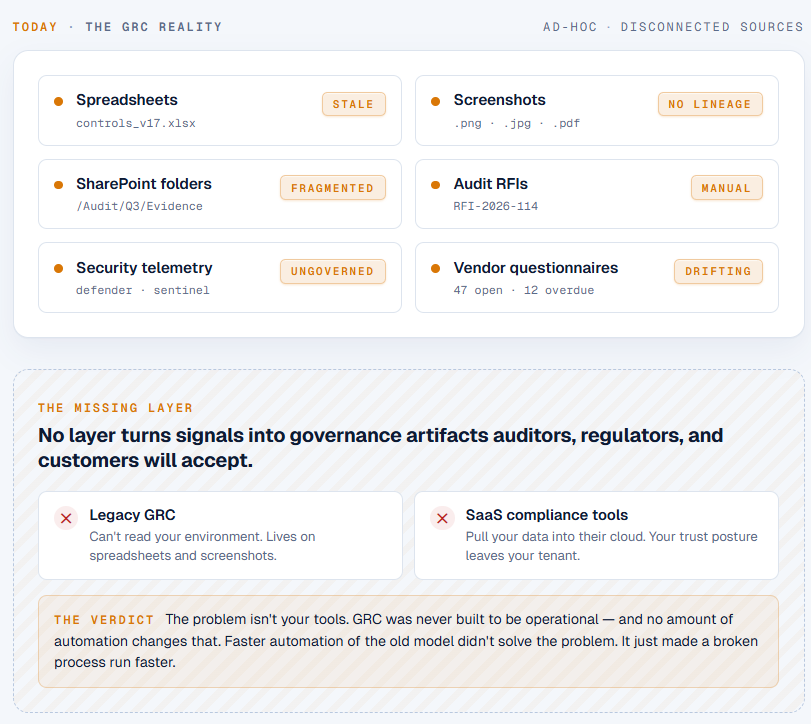
The GRC reality: disconnected sources like spreadsheets, screenshots, and vendor questionnaires, and the missing governance layer
The real cost of manual GRC

The cost of running GRC without an operating system.

Every quarter without continuous governance costs you in pipeline velocity, insurance premiums, team capacity, and market access. These costs compound whether you measure them or not.

Audit Cost
200–400hrs
per audit cycle

Every audit cycle starts from zero.

Without a continuous evidence layer, audit preparation consumes 200 to 400 hours per cycle. A missed audit window or material finding routinely runs $150K to $300K in remediation, re-audit fees, and consultant overruns. An enterprise deal lost to inadequate security posture carries $500K to $2M in lifetime value. The cost is not the audit itself. It’s running the audit as a project instead of a state.

With Kyūdō:Continuous evidence. Audits become reviews, not rebuilds.
Insurance Cost
20–40%
annual premium increase without continuous evidence

Insurance premiums must absorb the gap.

Underwriters now request API-level evidence of continuous monitoring, documented controls, and incident response posture. Organizations that can’t furnish this pay higher premiums, accept coverage gaps, or both. The rate increase isn’t a one-time cost. It compounds annually.

With Kyūdō:The evidence your underwriter requests already exists. Coverage improves because posture is provable, not promised.
AI Governance
Aug2026
first enforcement deadline

AI is in production. Governance is not.

AI-driven workloads are live across business units. The EU AI Act, ISO 42001, and NIST AI RMF have moved AI governance from voluntary practice to enforceable obligation. Most organizations have no centralized inventory, no risk classification, and no system of record to confirm AI governance at the board level. Existing GRC tools were not built for this.

With Kyūdō:AI governance as a native module. Inventory, risk classification, human oversight records, and audit trail, mapped to EU AI Act, ISO 42001, and NIST AI RMF from one control set.
Operational Exposure
30+days
added to deal cycle per security review

Deals stall in security review.

Enterprise prospects send vendor security questionnaires. Your team takes three weeks to assemble evidence manually. The competitor who produces a trust package in 48 hours moves to contract. The deal doesn’t die loudly. It goes quiet.

With Kyūdō:Security reviews answered in hours. Deals close on your timeline.
From Cost Center · To Capability

Kyūdō converts these costs into operating capability.

One control set. Every framework you answer to. Evidence that’s already true between audits, so readiness becomes how the organization runs, not what it scrambles for.

The Transformation

From Security Signals to Operational Trust.

Most organizations have modern security operations. Few have modern governance operations. Microsoft Security produces the operational truth. Kyūdō turns it into continuously governed, audit-defensible proof.

Old model
Governance Control Plane
01Security data
Defensible proof
02Audit preparation
Continuous readiness
03Manual evidence collection
Continuous evidence validation
04Framework-by-framework compliance
One governed control model
05Governance reconstruction
Governance operations
06Vendor-controlled SaaS
Sovereign deployment
07AI-generated answers
Explainable governance reasoning
08“Can we prove it?”
“Proof is already available.”
Business Outcomes of Continuous Readiness

The business case, for fewer scrambles, clearer evidence, and GRC that stays current.

For Finance and the Board

Audit costs drop. Compliance headcount stays flat as framework count grows.

Replace $80K–$250K in annual consultant fees with continuous, automated evidence. Scale from one compliance framework to four without adding headcount. When your auditor arrives, the evidence is already collected, mapped, and current.

For Sales and Revenue

Security reviews stop blocking deals.

Customer security questionnaires answered in hours, not weeks. Your Trust Center gives prospects self-service access to your compliance posture. Deals that stalled in procurement move through the pipeline.

For Risk and Legal

Your compliance evidence is current to the day, not the quarter.

Board-ready risk dashboards. Continuous control posture. When the regulator opens the file, the evidence is already true. EU AI Act, CMMC, SOC 2, HIPAA, ISO 27001: one platform, one evidence base.

The Governance Operating Model

Governance that operates. Compliance that proves itself.

Kyūdō transforms Microsoft security signals into continuously governed, audit-defensible proof.

By combining sovereign deployment, explainable governance reasoning, and operational AI governance, organizations move from audit preparation to continuous readiness.

Compliance becomes the byproduct of daily operations. Proof is already available when it’s needed.

Kyūdō is the drawn bow. The steady breath. The final alignment. The audit is uneventful when readiness is the operating condition.

Vector I
/deployment

Sovereignty-grade deployment

Kyūdō runs inside your Azure tenant - including the AI that reasons over your governance. Your data. Your identity plane. Your policies. No vendor access.

Vector II
/evidence

Microsoft-native evidence

Detection telemetry, identity posture, data classification, policy enforcement - your security stack already generates the signals. Kyūdō converts them into governed artifacts.

Vector III
/reasoning

Compliance Graph reasoning

Controls, evidence, risks, policies, and frameworks are typed entities in a unified graph. AI reasons over the graph. Every output is cited.

Vector IV
/ai-governance

Operational AI governance

156 AI governance controls. EU AI Act, ISO 42001, and NIST AI RMF built in. Govern the AI you deploy - using the platform that governs your controls.

Governance That Operates

How Kyūdō Works

Kyūdō connects to the Microsoft estate you already run, then turns its signals into continuously governed proof. Connect, govern, prove.

01
Connect

Connect your Microsoft environment.

Kyūdō reads the security and compliance signals already produced by your Microsoft stack. No migration. No data egress. No parallel infrastructure.

no migrationno data egressno parallel infra
02
Govern

Transform signals into governance.

Operational data becomes continuously governed evidence across compliance, risk, and AI governance requirements. One control model. Multiple frameworks.

one control modelmultiple frameworksSTRM crosswalk
03
Prove

Maintain continuous readiness.

Evidence is continuously validated, controls are continuously evaluated, and proof is always available when needed. No audit scramble. No evidence chase. Just readiness.

continuous validationcontrols evaluatedproof on demand
How Microsoft-native evidence works What makes a GRC platform AI-native
Who we built this for

For leaders who need more than compliance. They need proof.

Kyūdō is designed for organizations that already invest in security, risk, and governance, but need a defensible way to transform operational data into continuous readiness, audit-ready evidence, and explainable governance decisions.

CISO and Security Leadership

Gain continuous control assurance, reduce audit preparation, and prove security posture with evidence that is continuously validated.

Governance, Risk, and Compliance Leaders

Replace fragmented evidence collection with a single, governed source of truth that supports compliance across frameworks, regulations, and audits.

Internal Audit and Assurance Teams

Move from periodic reviews to continuous readiness with traceable evidence, control validation, and audit-defensible reporting.

CIOs and Technology Leaders

Maximize the value of existing Microsoft security investments by turning operational telemetry into measurable governance outcomes.

AI Governance and Risk Teams

Operationalize AI governance with explainable reasoning, evidence-backed decisions, and readiness for emerging regulations and standards such as the EU AI Act, ISO 42001, and NIST AI RMF.

Built for organizations where readiness is an operating condition, not an annual event.

The platform

Continuous Readiness. Defensible Proof.

Most organizations operate security continuously but govern it periodically.

When audits, customer reviews, regulatory inquiries, or board requests arrive, teams scramble to collect evidence, validate controls, and prove compliance.

Kyūdō changes the operating model.

By continuously transforming operational data into governed, evidence-backed proof, readiness becomes a maintained condition, not a recurring project.

The result:

  • Continuous evidence validation
  • Audit-defensible compliance
  • Explainable AI governance
  • One control model across frameworks
  • Governance that remains inside your environment

Six integrated capabilities. One Governance Control Plane.

When someone asks for proof, it’s already there.

Compliance Graph · live
ControlsEvidencePolicyRiskVendor RiskTrust
/controls

Controls Hub

The authoritative registry. Controls auto-discovered from integrations, mapped to 80+ frameworks via STRM, and scored for completeness on a 0–100 scale.

AC.L2-3.1.6 · CC6.1 · 1,247 active
/evidence

Evidence Hub

Automated collection from Microsoft Security and cloud platforms. Every artifact carries hash, lineage, and a confidence score.

evidence://refresh · 14:22 UTC
/policy

Policy Center

AI-authored policy grounded in linked controls. Continuous gap analysis. Citation on every draft. Policy as a living entity, not a document.

AC.L2-3.1.6 · CC6.1 · 1,247 active
/risk

Risk Management

Risks linked to controls and evidence. Posture reflects live operational reality. Board-ready dashboards present exposure as a trajectory.

residual: 4.2 → 2.8
/vendor

Vendor Risk Management

Automated questionnaire handling with cited responses and AI-scored vendor posture. Continuous monitoring, not annual review.

247 vendors · 12 high
/trust

Trust Center

Customer-facing transparency portal. Questionnaire pre-fill with citations and confidence scores. Security reviews compress from weeks to hours.

weeks → hours
The differentiator

Your Data Never Leaves Your Environment

Deploy inside your Azure tenant. Maintain complete control over governance evidence, AI governance artifacts, and compliance data.

Explore the customer-hosted architecture
01
No cross-tenant data plane
Every Kyūdō service runs inside your Azure subscription. There is no path for compliance data to reach vendor infrastructure, because no such path exists in the architecture.
azure subscription · resource group
02
Private endpoints on every service
Application services, storage, Key Vault, SQL, Identity, and AI inference - every service exposes private endpoints only. Traffic never leaves the Microsoft backbone.
private endpoints · ms backbone
03
Tenant-scoped AI inference
AI operations execute on Azure OpenAI Service or other AI endpoints of your choosing within your tenant. Prompts, retrieved context, and responses do not leave your data boundary.
azure openai · in-tenant

Start where your data
already belongs
inside your tenant.

your environment · self-sovereignty maintained
Frequently Asked

What teams ask when evaluating Kyūdō

Looking for more? See all frequently asked questions.

The question that matters

Can You Prove It Right Now?

If your board asked for proof. If an auditor asked for evidence. If a customer demanded assurance. Would your team already have the answer, or would governance become a reconstruction project? Kyūdō makes proof a continuously maintained condition, not an event.

Book a Deployment Workshop See Continuous Proof in Action
Operational trust, maintained